Social media runs on mood
Three posts today, then a silent week. The plan lives in one person’s head, the photos on their phone, the passwords in a chat. They fall ill — the channels stop.
Diwave Marketing · an AI marketing team
Your team drops links and thoughts into the messenger it already uses — WhatsApp, Viber or Telegram. The system turns them into a weekly plan, videos, posts and articles. Every Monday you see what went out, how many leads came in and whose idea brought them.
You are the editor-in-chief: nothing goes out without your “yes”.
The mood and energy of everyday work — in the warehouse, on delivery runs, in sales and in the director’s office — flow into the system. It makes sense of it all, and your team spirit goes online through your own videos and your own point of view.
The problem is rarely the budget or the networks. It is that nobody collects ideas, keeps the rhythm or counts the result in leads.
Three posts today, then a silent week. The plan lives in one person’s head, the photos on their phone, the passwords in a chat. They fall ill — the channels stop.
Impressions, likes, followers — nice charts that never answer the owner’s one question: how many people wrote or called afterwards.
The driver hears what customers ask, the warehouse sees what sells, sales hear the complaints. That is the best content you have, and it gets lost in private chats.
Warehouse, driver, sales, director, investor — each sends a link, a photo or a short note to the bot in your work messenger (WhatsApp, Viber, Telegram) or the dashboard: “customers keep asking about this”.
It reads the linked page, looks at the photo, checks it against your products, the season and what has already gone out. The result is an idea card with its author and format.
Cards are assembled into a weekly plan. The team comments and votes — you see which ideas the people who talk to customers every day back.
Every piece gets “Approve”, “Rewrite” or “Reject”. A rejection reason becomes a tone rule, so the system does not suggest it again.
Videos, posts, Stories and articles go out on schedule. Every Monday the owner gets a report: what went out, how many leads came in and whose idea brought what.
Four frames from the interactive demo. The company, people and figures in it are made up — an example, not our results.
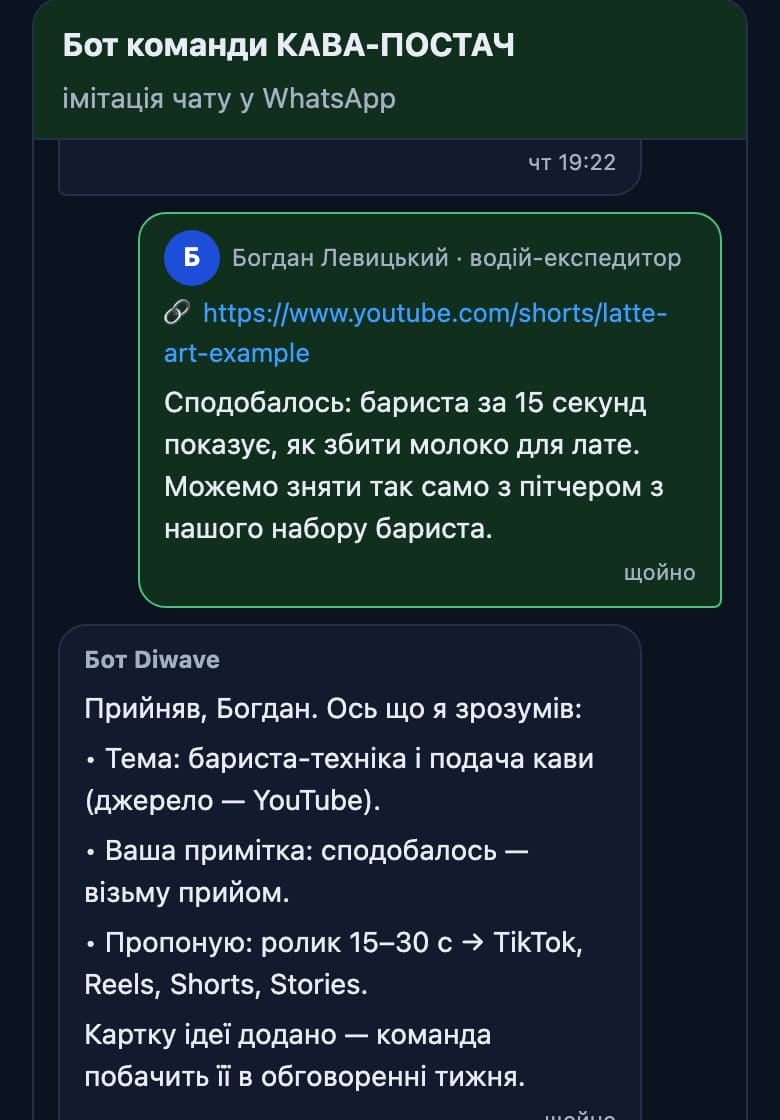
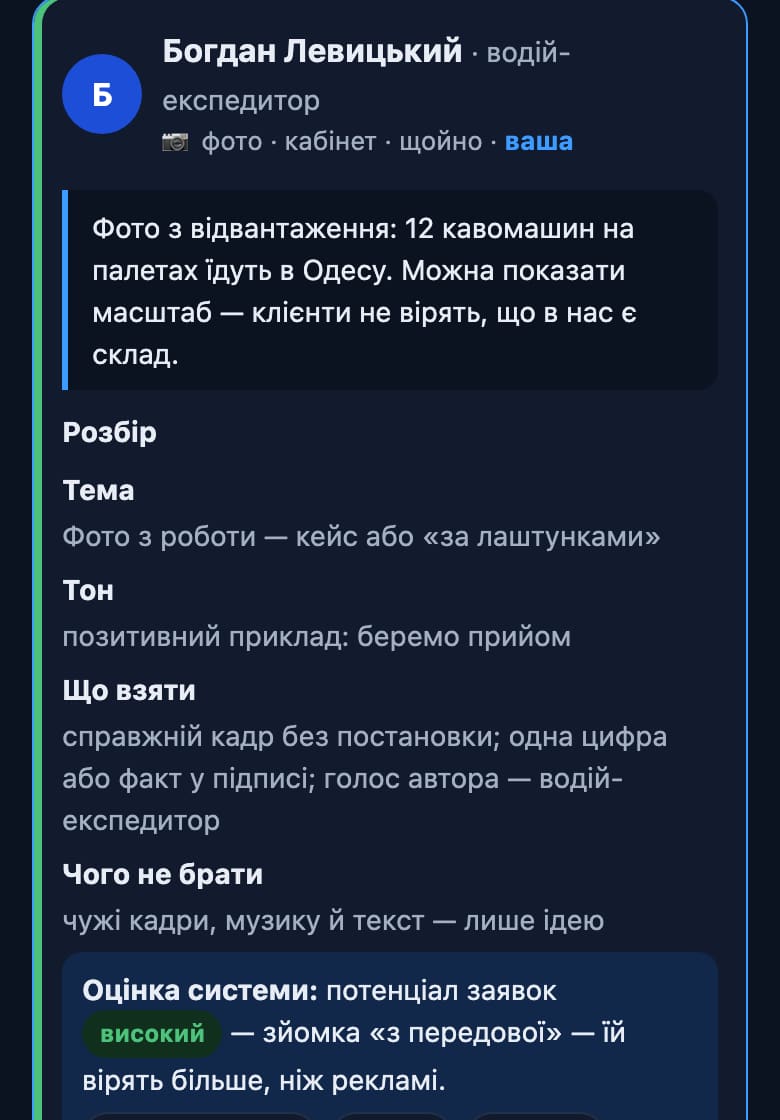
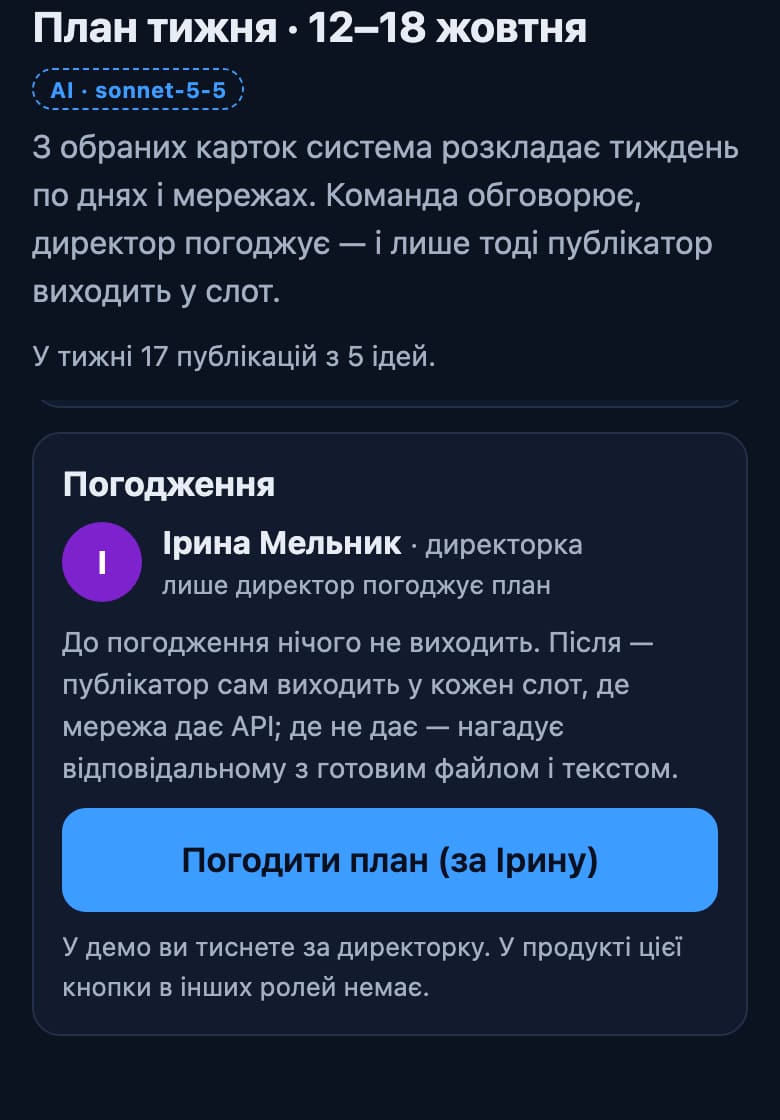
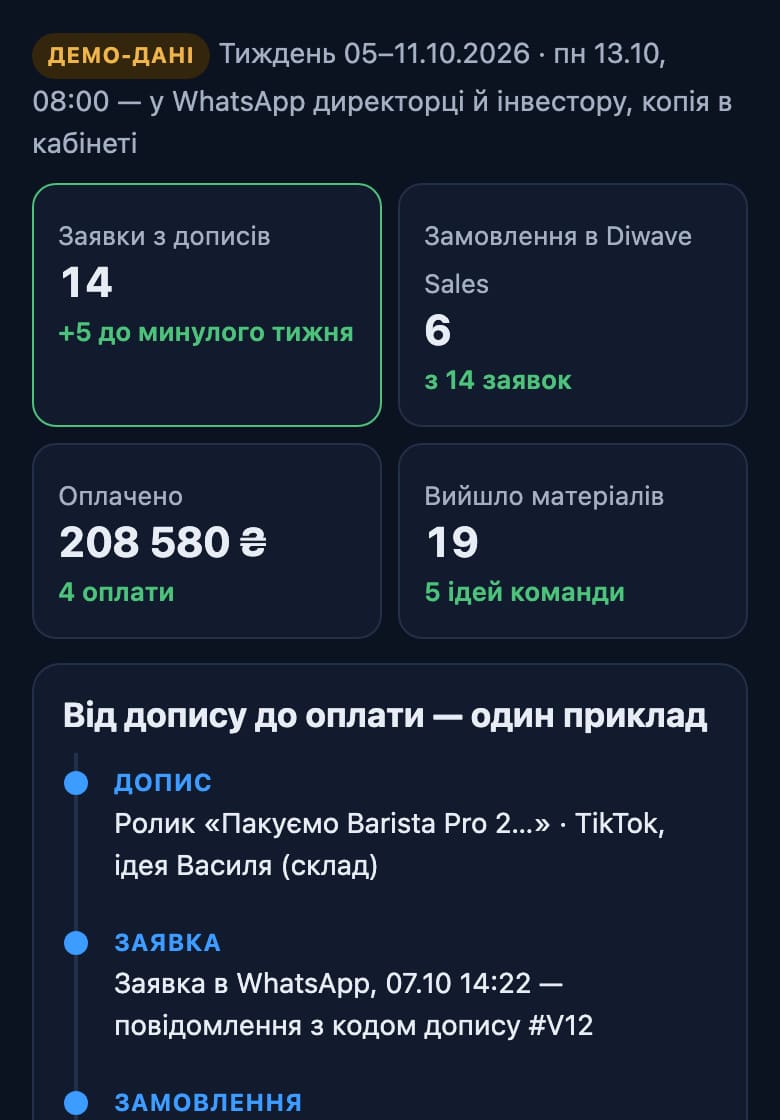
No sign-up: you play the driver, the team and the director in turn — from idea to report. The demo interface is in Ukrainian.
Six roles a small or mid-sized business rarely affords together — and the “ChatGPT + Canva + a planning spreadsheet” kit that depends on one person.
What it does not replace: your judgement, on-site shooting — your team takes the photos and videos — full video editing (a separate service) and your ad budget.
Customers no longer search only on Google: they ask voice assistants and ChatGPT. The system writes so that you are found in all three places.
Articles for searches people actually type — with volumes from keyword tools, not guesswork. Proper headings, structured data, internal links.
Short, precise answers to customer questions plus FAQ markup — what Google and voice assistants read out first.
AI assistants answer with what they can quote: facts with figures, clear structure, your name next to the topic. The system writes exactly that way — using only facts from your own reference sheet.
Together with Diwave Sales
Marketing brings a person into the chat; Diwave Sales takes them to the invoice and payment. Together they answer the question no agency closes: which post actually brought the money.
We run our own channels and a partner’s Facebook page this way: topic gathering, a planning meeting, drafts, a yes/no approval page, publishing only what was approved, and tracking the result. Our main measure is the same as in the product — conversations about orders, not impressions.
We only publish figures that can be reproduced by a query against the production database. We will publish the pilot results after 4 weeks — with the measurement date.
Some platforms review an app before they allow publishing through their API. Until access is granted, the system prepares the piece in full and you publish it in one tap when reminded.
One-off setup plus annual support. The price depends on volume — members, videos and articles — not on the number of networks. The exact figure comes after a call.
from €4,000
setup
from €2,400 per year — support
from €8,000
setup
from €4,800 per year — support
Support is paid a year in advance. No monthly payments, no instalments.
The decision is yours: the system publishes nothing without your “yes”. We are responsible for keeping it running, taking figures, prices and facts only from your reference sheet, and flagging anything unconfirmed. Every rejection with a reason becomes a rule, so drafts move closer to your tone week by week.
Yes. Then the system brings the ideas itself — customer questions, seasonality, keyword research, trends in your field — and you approve. A team makes content come alive: photos from the warehouse and real customer questions are something a model cannot invent.
Ukrainian and English. Other languages are set up during onboarding — tone, banned topics, your glossary — so content goes out in your customers’ language.
On a dedicated server with its own database — one client’s data never mixes with another’s. Access is role-based. Photos and videos showing people are marked “consent needed” until you confirm it. We sign a DPA, and the system can run on your own server on request.
Nothing is lost: the piece moves to “ready to publish”, you get a reminder and post it manually in one tap. Adapting the integration to the platform’s new rules is part of annual support.
The work is in each video and each article, not in each platform: one approved video is adapted for several networks. Paying per network means paying for a checkbox, not for the content that brings leads.
The plan includes the script, text, music and short clips cut from your footage on a template. Full video editing is a separate service by arrangement, quoted per video or series.
Whichever messenger your team already uses: WhatsApp, Viber, Telegram or another. Ideas go straight to our bot — we recognise each member by their account. Telegram is the simplest to connect. For WhatsApp conversations with your customers you use your own company number through the official WhatsApp Cloud API. No personal number is needed.
You move up to the larger plan. We do not sell videos or articles one by one: that keeps the price predictable for you and the quality the same for every piece.
Google penalises faceless mass content, not the tool. That is why volume is capped by the plan, every article passes your approval, and the facts and photos are yours rather than invented.
You do, directly to Meta, from your own WhatsApp Business account. It is not part of the setup or support price: the rate depends on conversation type and country and changes over time, so we do not resell it.
Open the dashboard demo — or tell us what you sell and who on your team talks to customers, and we will say plainly what Diwave Marketing would change and what it would not.