Project sourcing and delivery
We take on finding the people, running the project and shipping it: from discovery and design through development, QA, DevOps and launch.
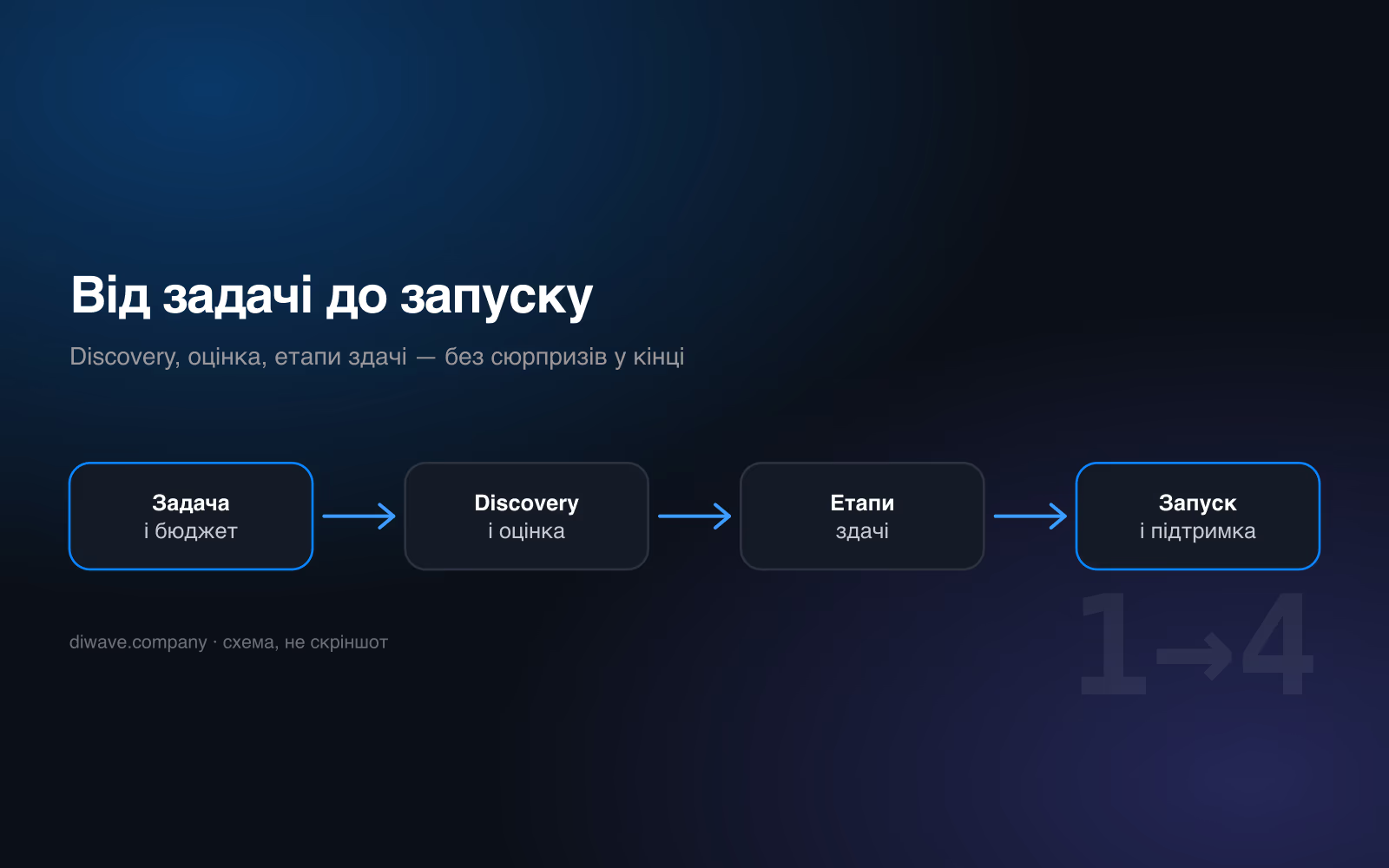
Roles and responsibilities
- PM / Delivery:plan, risks, timeline, budget, communication.
- Tech Lead:architecture, stack, code review, security, performance.
- Design → QA → DevOps:UX/UI, prototypes, tests, CI/CD, monitoring.
How it works
1. Interviews and requirements
We start with a conversation, not an estimate. Interviews with the people who will use the system produce the requirements; the requirements become a backlog, and the backlog becomes an estimate and a budget.
2. Staffing
We source the specialists the job actually needs: design, development, QA, security. The team is assembled to match the backlog, not a one-size-fits-all crew kept just in case.
3. Architecture and stack
The tech lead settles the architecture and the stack before the first line is written, then holds code review, security and performance for the rest of the project.
4. Development with prototypes
UX/UI and prototypes run ahead of the code, tests run alongside it. The PM holds the plan, the risks, the budget and the communication, so the client sees the state of the work rather than a report after the fact.
5. Launch
DevOps prepares CI/CD and monitoring, QA closes out the tests, and the system goes to production under an agreed SLA.
6. Growth
After launch there is analytics, optimisation and a roadmap: the product keeps moving instead of freezing at its launch version.
What to check before you start
- Whether someone on the client side can answer the discovery interviews — without that person the requirements are assembled from guesses.
- Whether the scope is written down: the backlog and the estimate have to rest on the same list.
- Who decides on budget — the PM holds the budget but does not replace the person whose money it is.
- What the security requirements are: they are cheaper built into the architecture than added after launch.
- What SLA is needed after launch and who provides it — that decides the shape of the DevOps side.
Frequently asked questions
Do you find people or run the project?
What does discovery include?
What happens after launch?
Answers on this topic
Plain explanations without marketing — useful even if you never hire us.
Custom system or an off-the-shelf box: an honest comparison
When a boxed product wins, when custom wins, and the third option: a working system adapted to your process. Lock-in, code ownership, support, migration risk.
Replacing 1C: what to migrate first
The order of migration away from 1C: where to start, what can stay for years, how to avoid stopping the business mid-transition, and where data goes missing.