Business process automation
You cannot automate «the business». You can remove one specific action a person repeats by hand every day — and measure how much time that gave back. Then the next one.
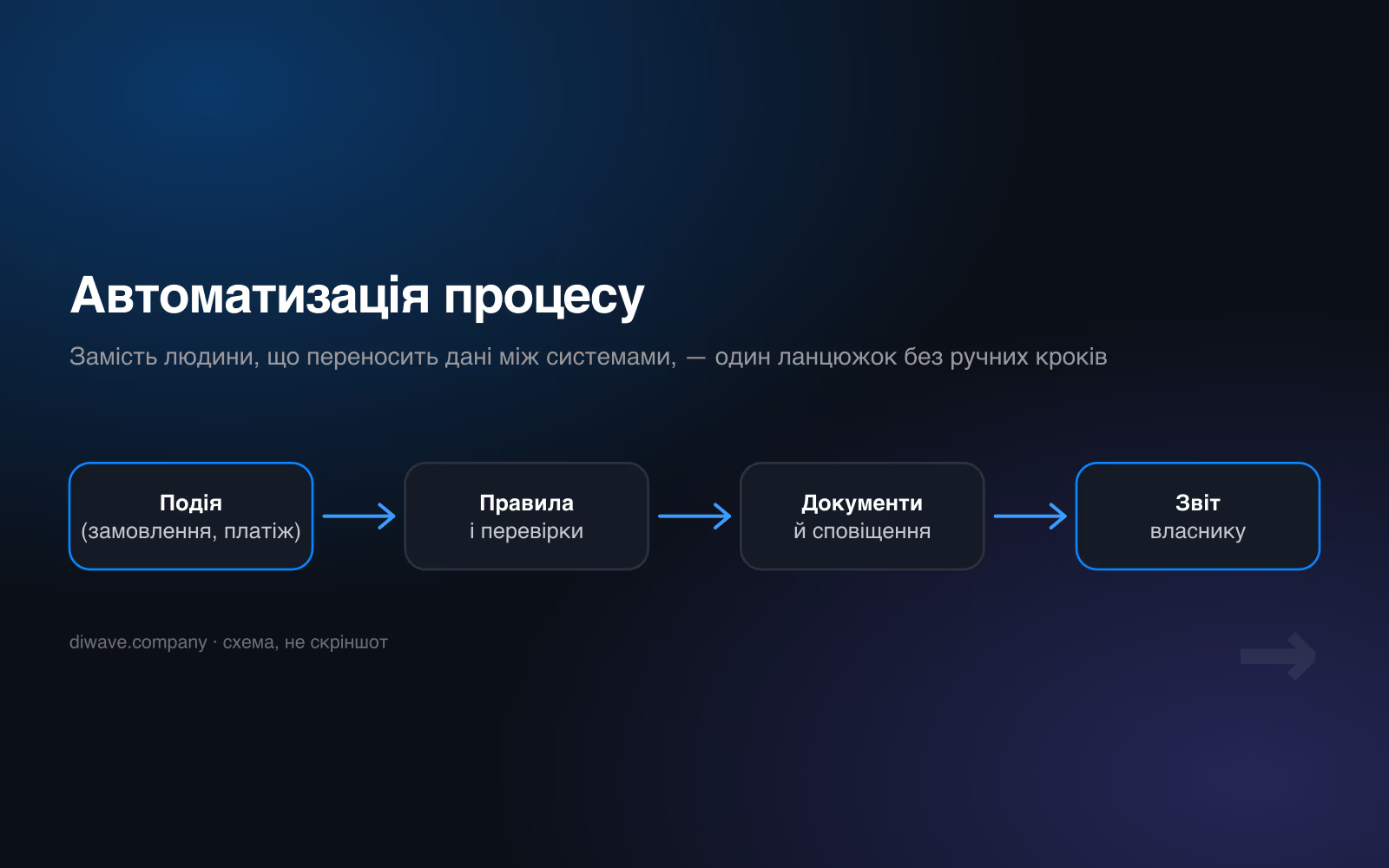
What we automate
Under each area, not a promise but something already built and running for its owner.
- Stock and inventory
- Goods reserved for an order cannot be sold twice. Stock in the warehouse and stock on the storefront are one number, not two that somebody reconciles weekly. Receipts, write-offs and transfers leave a trail that shows where the goods went.
- Built: warehouse-to-storefront sync on a 7,422-product catalogue.
- Production and equipment
- A line driven by software rather than by a person with a button. Conveyors and pumps start and stop to a plan, and the state of the line is read back — so the system knows what actually happened, not what was supposed to. Weight sensors show how much material a run really consumed: the number the plant manager wants and rarely has.
- Built: Raspberry Pi and Pi Pico as industrial controllers on a working production site.
- Trade and orders
- An order runs from the customer’s first message to shipment with no manual copying between spreadsheets. Pricing follows your rules, not a manager’s memory. Status is visible to everyone who needs it and to nobody who does not.
- Built: 260 orders and 144 clients in our own system, 20 months in production.
- Documents and billing
- Invoices, acts, contracts and delivery notes are built from data. Monthly billing runs on a schedule rather than when someone remembers. Company details live in one place — an edit changes the document, the database and the payment page together.
- Built: 196 documents generated without a human; a separate contract billing system.
- Nesting and materials
- Part layout on the sheet is computed, and offcut is accounted for as a cost line, because that is what it is. Geometry, machine toolpaths and remnant tracking live in one system rather than in three people’s heads.
- Built: a nesting platform with offcut accounting; parts modelled in SolidWorks and Fusion, toolpaths in CAM.
How we work
- 1. Find the action, not the process
- You cannot automate «the business». You can remove one specific action a person repeats by hand every day. The first week goes on finding those: what gets exported, what gets reconciled in a spreadsheet, what gets retyped from one window into another. That is where the hours are — not where the complaints are loudest.
- 2. Measure before
- How many times a day, how many minutes each, what a mistake costs. Without that number «it got better» cannot be demonstrated — not by us, not by you to yourself. It is the dull step everyone skips, which is why most automation projects have no result anyone can show.
- 3. Build narrow, ship it
- One action, finished and put into use, is worth more than half a system waiting for the rest. People start using it, and it immediately becomes clear what is actually needed next and what only looked necessary on paper.
- 4. Measure after
- The same number, the same method. If nothing changed, that is important information — and better learned on one action than on an entire system.
What backs this up
Our own sales and document system has run for 20 months: 260 orders, 196 documents with no human involved, 3,332 messages handled by the bot, role-based access for 6 staff. Figures reconciled against the live database on 14.09.2026 — a query, not an estimate. Numbers we cannot reproduce with a query do not go on this site.
Frequently asked
Where do we start if everything is manual?
What does automation cost?
Do we need to replace equipment?
What happens to the people whose work is automated?
What if we already have a system and it does not fit?
Answers on this topic
Plain explanations without marketing — useful even if you never hire us.
SCADA, CRM and ERP: how they differ and what you need
Plain explanations of the difference between SCADA, CRM, ERP and WMS. What each one is for and why replacing one with another usually ends badly.
Automating invoices, contracts and delivery notes
Why salespeople lose hours to paperwork and what to automate first. A worked example: 196 documents generated by the system with no manual typing.
Replacing 1C: what to migrate first
The order of migration away from 1C: where to start, what can stay for years, how to avoid stopping the business mid-transition, and where data goes missing.
Custom system or an off-the-shelf box: an honest comparison
When a boxed product wins, when custom wins, and the third option: a working system adapted to your process. Lock-in, code ownership, support, migration risk.
ok:true does not mean delivered: request vs result
Why a successful API response only means “accepted”: WhatsApp, a payment terminal and a fiscal receipt as examples, and how to check the actual result.