Messenger bots that actually sell
An autoresponder answers questions. A sale is when the order reaches shipment and the paperwork writes itself. The distance between those two things is the whole job.
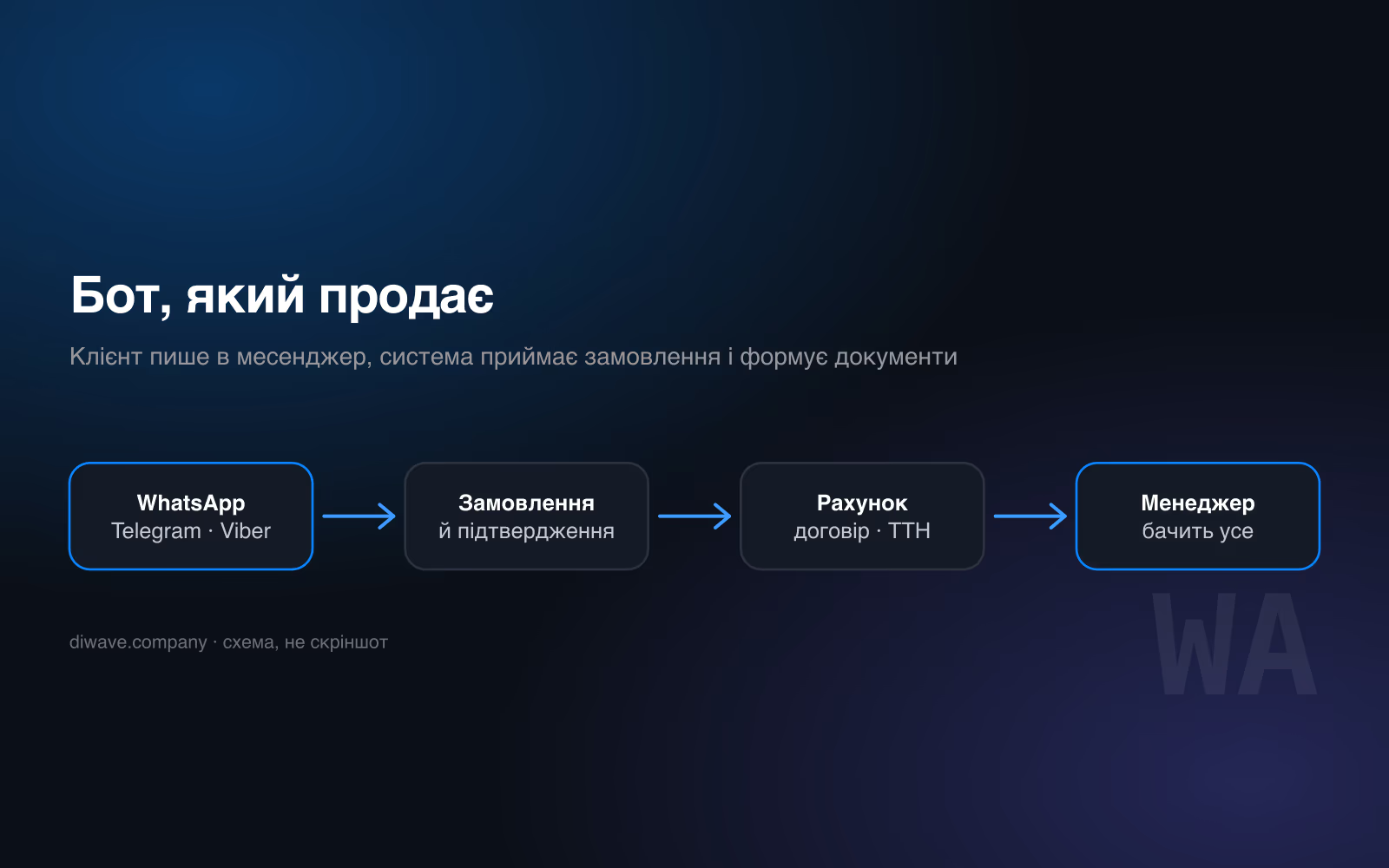
This already runs
A WhatsApp bot has been driving sales for 20 months: 3,332 messages handled, 260 orders, 144 clients, 196 documents generated without a human. Customer document data is extracted from photographs. Figures reconciled against the live database on 14.09.2026 — measured, not estimated.
How the conversation goes
- The first message
- People write what they are thinking, not what the menu expects: «how much», «do you have it in stock», a forty-second voice note. A button-driven bot has already lost here — the customer either taps «other» or leaves. You have to parse real language.
- Clarifying and pricing
- Only the questions that matter, none of the filler. The price comes from the database, never from the model’s memory — this matters: a model that invents a price does it confidently, and the customer sees the mistake before you do.
- Paperwork
- Invoice, contract, delivery note and carrier waybill built automatically from the order. This is where half a day of someone’s week usually hides — and where a mistake costs the most.
- Handing over to a person
- The bot has to know when to stop talking. An unusual question, an annoyed customer, an amount over a threshold — the conversation goes to a human with the full context, not from scratch.
Three traps that quietly kill bots
We hit all three in our own system. Worth knowing before you pay anyone to build one.
- The 24-hour window
- WhatsApp only lets you message freely for 24 hours after the customer’s last message. After that, only an approved template. This is where most bots quietly break: the broadcast «goes out», the API returns success, and nothing arrives. It belongs in the architecture, not in a surprise on live customers.
- «ok: true» does not mean delivered
- The messaging API confirms it accepted your request, not that a human saw the message. The difference only shows in the delivery log, and it has to be checked after every send. We were caught by this once — now the system checks itself.
- A bot that invents
- The most expensive failure is not technical. A model without access to the data will confidently quote a price, a lead time and availability — and the customer will remember it. In a working system the model may not assert anything the data does not contain: it phrases, it does not decide.
Frequently asked
How is this different from a bot builder?
What does a bot cost?
Can it connect to our existing CRM?
How many people does it take to run?
Answers on this topic
Plain explanations without marketing — useful even if you never hire us.
Selling on WhatsApp: the 24-hour window and lost messages
How the WhatsApp Business API actually behaves: the 24-hour window, templates, and why an "ok" from the API does not mean the customer saw your message.
Automating invoices, contracts and delivery notes
Why salespeople lose hours to paperwork and what to automate first. A worked example: 196 documents generated by the system with no manual typing.
Custom system or an off-the-shelf box: an honest comparison
When a boxed product wins, when custom wins, and the third option: a working system adapted to your process. Lock-in, code ownership, support, migration risk.
ok:true does not mean delivered: request vs result
Why a successful API response only means “accepted”: WhatsApp, a payment terminal and a fiscal receipt as examples, and how to check the actual result.