Software for self-service car washes
The payment and telemetry layer between the wash bay, the customer’s phone and the books: bay control, cash, card and QR, a fiscal receipt, shift reconciliation, an owner dashboard. We do not build the hardware — we write what runs on it.
Car wash networks
The bays are up and running, but revenue is counted by hand and the owner hears about a fault from a customer. What is missing is a layer that brings payment, telemetry and the till into one system.
Equipment manufacturers
You build the hardware and do not want to write the payment side from scratch. The software is licensed separately from the equipment and connects to your controllers.
Operators with hardware already in place
The wash only takes coins and notes while customers ask for card and QR. Replacing the bays is not required — access to the controller is.
What is inside
Eight parts that have to work together. The most common mistake at launch is doing the first three and skipping the rest: the bays run, the money comes in, and the owner still does not know what the site earned yesterday.
- Bay control
- Modbus RTU and Modbus TCP to the bay controllers: which bay to start, on which program and for how long. The remaining time is counted on site, not in the cloud.
- Cash: ccTalk and MDB
- Note validators over ccTalk, coin mechs over MDB. Every note and coin lands in the same ledger as the cashless payments — otherwise the shift will not add up.
- Card and QR
- A contactless terminal on the bay, or a QR code and payment in the browser with Apple Pay and Google Pay. Both channels end in the same command: start the bay.
- Offline mode
- Losing the internet does not stop the wash. Transactions are written locally, receipts queue, telemetry accumulates; when the link returns everything is backfilled without duplicates.
- Shift reconciliation
- Three numbers per shift: what the bay counted, what the bank confirmed, what is physically in the cassette. One gap is a fault. The same gap in the same shifts is not a fault.
- Fiscalisation
- The receipt reaches the tax authority at the moment of payment, shifts open and close with no person present, and the queue survives hours offline. A separate log shows what was taken and what was fiscalised.
- Owner dashboard
- How much went through each bay per shift, how long bays stood idle, which errors occurred, when the cash was last collected. The owner sees the site without driving to it.
- Customer app
- Payment from the phone, balance, wash history, promotions. The same payment path as the terminal — the customer sees no difference and reconciliation stays a single one.
Where it already runs
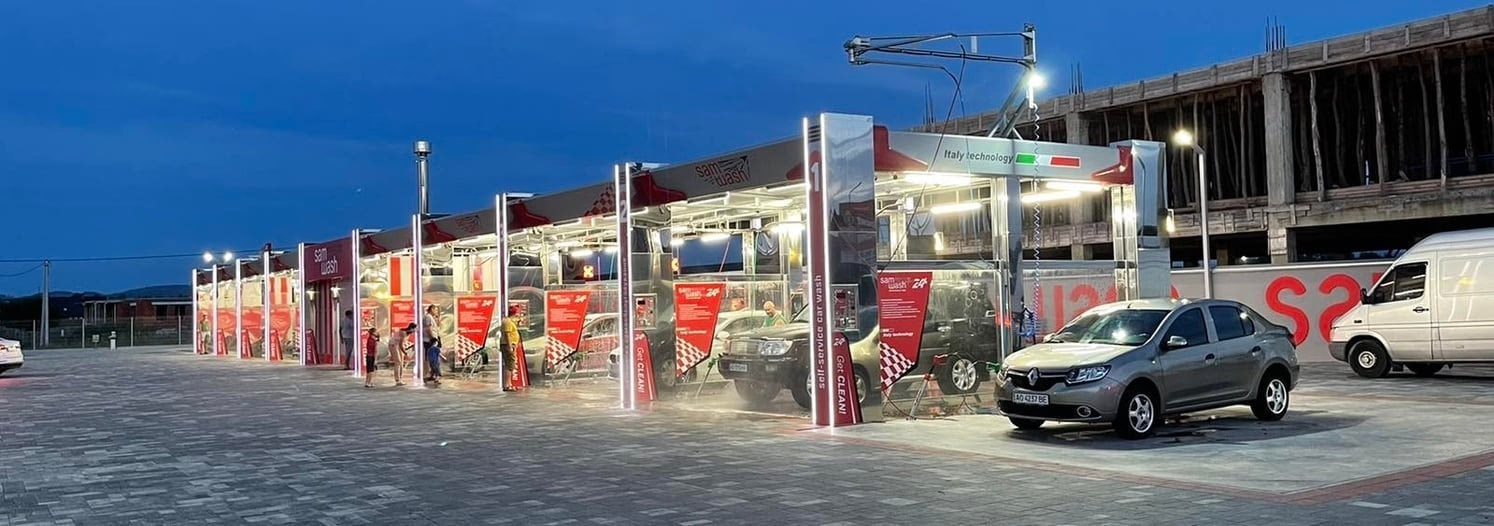
Across the SamWash self-service car wash network, where Diwave is the technology partner. 14 million payment transactions have passed through this payment layer. Both interfaces are open and running right now: app.samwash.ua — the customer app, admin.samwash.ua — the owner dashboard.
SamWash manufactures the hardware; Diwave is responsible for everything that happens after the car pulls in: how the customer pays, how the bay learns it may start, how the money reaches the books, and how the owner sees all of it from afar. That is a separate job, and it does not depend on whose hardware is on site.
How we connect to hardware you already have
- 01Survey the controller
We look at what is on the bay and what it exposes: is there Modbus, which note validator, which protocol the coin mech speaks, is there anywhere to attach a terminal. The equipment model often answers this before any site visit.
- 02Integration on one bay
One bay, the full loop: payment, start, receipt, telemetry, per-shift reconciliation. A week of real customers shows more than any spec, and keeps mistakes cheap.
- 03The network
The same setup rolls out to the remaining bays and sites: one dashboard, one reconciliation, one receipt queue. New sites are added as configuration, not as a new integration.
Not only the code
Dmytro ran all of SamWash’s advertising himself — Google, Facebook, Instagram, TikTok, YouTube, the blog, influencer work. So we know the car wash business from more than the code side: it is visible what actually brings a customer to a bay, and how that shows up in the payment data the next day.
Frequently asked
Answers on this topic
Plain explanations without marketing — useful even if you never hire us.
What self-service car wash automation actually costs
What automating a self-service car wash actually costs: the equipment, payment acceptance, telemetry and the software — with the ranges named openly.
Car wash payments: from the bay controller to reconciliation
How payments work at a self-service car wash — coins, notes, cards and QR — what has to be reconciled every day, and where the revenue quietly leaks.
Inside a self-service car wash terminal
What a car wash terminal is made of: plate recognition, payment acceptance, fiscal receipts, controller link, telemetry. What breaks first and why.
Telemetry where the link drops for hours
Telemetry where the mobile link drops for hours: store-and-forward, clock drift, deduplication, staleness on the dashboard, alerts that do not cry.
Three abuse patterns at unattended machines in the data
Starts without payment, short cash collections, scheduled “breakdowns”: how each abuse pattern shows in car wash and vending data, and why cameras see it last.