Payments and fiscalisation for self-service equipment
We write the software that sits between the hardware and the bank: it takes payment on the machine, issues a fiscal receipt with no cashier, and reconciles revenue per device every day.
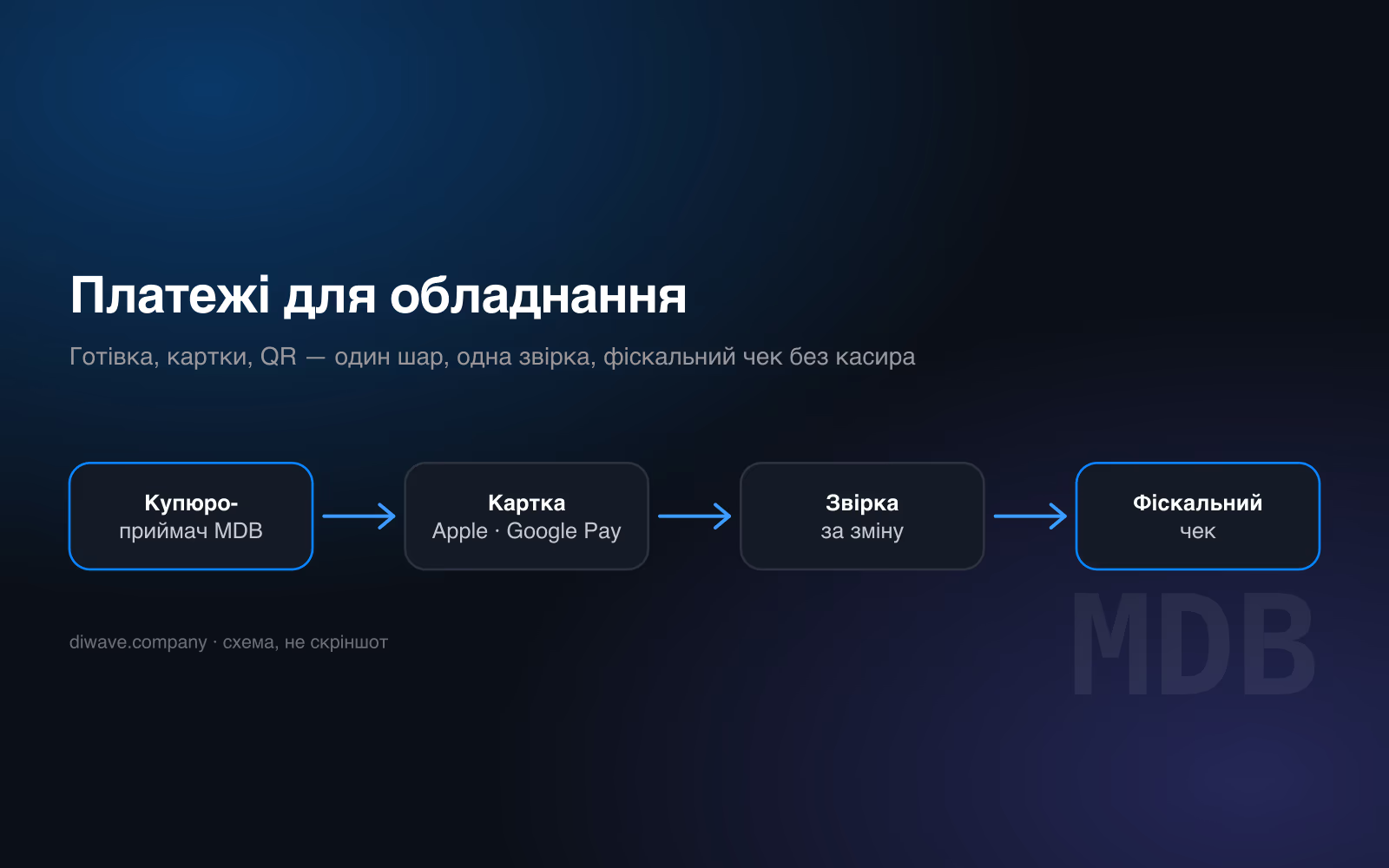
What we actually do
- Taking payment on a machine
- Card, cash, QR, contactless terminal — each is a different protocol with a different failure mode. The bill validator speaks ccTalk, the coin unit and payment module speak MDB, the bank terminal has its own protocol over a serial port. Our job: the machine delivers the service exactly once, and only when the money actually moved.
- A fiscal receipt with no cashier
- A software cash register is not «install an app». It is device registration, shifts that must open and close, a receipt queue for the hours when the link is down, and retries that do not duplicate. A machine has nobody to press «try again», so the software has to do all of it and lose nothing.
- Revenue reconciliation per device
- Three sources of numbers: what the machine counted, what the bank reported, what is physically in the cassette. They never agree on their own. We reconcile them daily and show the gap per device — that is where both a failing bill validator and staff abuse become visible.
- Remote supervision
- The owner should see every device without driving to the site: online or not, how much it took this shift, which errors repeat. Telemetry is built to survive hours of lost connectivity and send the backlog afterwards rather than going silent.
What backs this up
Defender-3, our own sales and document system, has run for 20 months: 260 orders, 196 documents generated without a human, 3,332 messages handled by the bot. Figures reconciled against the live database on 14.09.2026.
The payment and fiscal side runs across a self-service car wash network — where a machine stands unattended around the clock and every fault costs that day’s revenue.
What the cost is made of
There are no figures here on purpose: quoting one before seeing the hardware means guessing. Here is what moves it several times over.
- How many different devices
- One machine type versus ten is not a difference in volume — it is a difference in how many protocols must be learned and then maintained.
- Whether fiscalisation is needed
- A software cash register adds registration, shifts, a receipt queue and liability for every lost receipt. Without it the task is several times smaller.
- What connectivity the site has
- Stable internet and a mobile link that drops for hours are two different architectures, not a setting.
- What already exists
- Sometimes the hardware can already do more than the owner thinks and the task becomes integration. Sometimes the opposite: the model does not support the required mode at all.
Frequently asked
What does it cost to add payments to a machine?
Can a software cash register run on an unattended machine?
Do you work with existing hardware or only your own?
What happens when the site loses internet?
How do I see whether staff are taking money?
Answers on this topic
Plain explanations without marketing — useful even if you never hire us.
Wero and ENP: what changes for unattended terminals
Europe is building its own account-to-account payment network, ENP and Wero. What it means for car washes and vending, and how to prepare now.
EU PSR: the Council position and unattended payments
On 29 Oct 2026 the EU Council unanimously adopted its PSR position: IBAN–name checks, spoofing liability, phone features for third-party apps. What it means.
Unattended payments: what actually breaks outdoors
What fails in an unattended terminal standing outside: note acceptors in frost, dropped links, receipts, reconciliation. From a network that runs today.
Car wash payments: from the bay controller to reconciliation
How payments work at a self-service car wash — coins, notes, cards and QR — what has to be reconciled every day, and where the revenue quietly leaks.
Fiscal receipts from a terminal with no cashier
How a receipt reaches the tax authority from an unattended terminal: who issues it, when, what happens when the link drops, and where the gap usually appears.