Card acquiring for vending and unattended machines
Card, phone or QR on an unattended machine, a fiscal receipt, revenue reconciled per machine — on the hardware you already have.
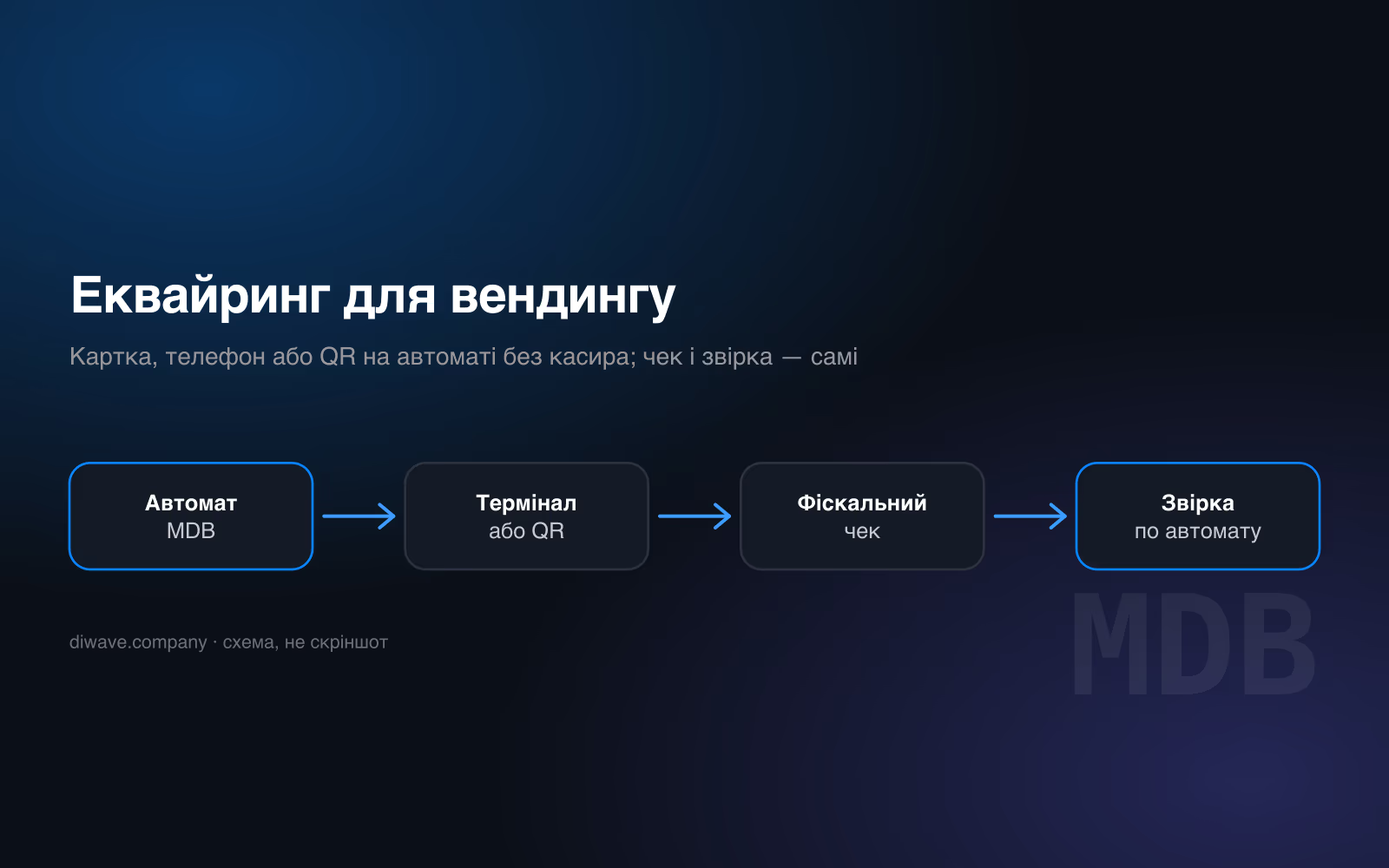
Three ways to take payment on a machine
- A bank terminal on the machine
- A contactless reader from the bank or a payment provider, wired to the machine board. The terminal speaks its own protocol, the machine speaks MDB. Our module sits in between: it takes the payment confirmation, commands the vend and records the transaction so it can be matched to the bank statement.
- QR payment with no terminal
- A code on the machine; the customer pays in the browser with a card, Apple Pay or Google Pay. Nothing is added to the machine and the money lands in your account directly. It fits when a terminal on every machine would not pay back.
- Cash stays
- The ccTalk note validator and the MDB coin mech stay: some customers only pay cash. The software runs every channel in one till and shows the share of each — that is how you see when the terminal has paid for itself.
- Fiscal receipt with no cashier
- A software cash register on the machine: device registration, shifts opened and closed without a person, a receipt queue for the hours the link is down, retries without duplicates. The customer gets the receipt by QR or on the phone.
What backs this up
The payment layer described here runs across a self-service car wash network: bay controllers over Modbus, note and coin acceptors over ccTalk and MDB, cards, QR, per-shift till reconciliation. The terminal keeps taking payments when the internet drops and backfills once the link returns. To this software a vending machine is the same task in a different cabinet.
What the cost is made of
No figures here on purpose: a number before seeing the hardware is a guess. Here is what moves it several times over.
- How many machines and which
- Ten identical machines are one integration. Ten different ones are ten protocols and ten failure modes.
- Terminal or QR
- A terminal on every machine means hardware, rental and fees; QR is software only. Often the answer is both: terminals where traffic is high, QR everywhere else.
- Whether fiscalisation is required
- With a software cash register the task is several times larger: registration, shifts, a receipt queue, liability for every lost receipt.
- Connectivity on site
- A machine in a mall basement and a machine on the street are different architectures: the first is almost always online, the second must run without a link for hours.
Frequently asked
What is vending acquiring in plain words?
Will my old machine work?
What does it cost to add acquiring to vending?
The machine is where the internet drops. Then what?
How do I see money is not disappearing between machine and bank?
Answers on this topic
Plain explanations without marketing — useful even if you never hire us.
Unattended payments: what actually breaks outdoors
What fails in an unattended terminal standing outside: note acceptors in frost, dropped links, receipts, reconciliation. From a network that runs today.
Card payments for vending machines without a cashier
MDB reader, bank terminal or QR: three ways to take cashless payments on a machine, fiscal receipts without a cashier, per-machine reconciliation, offline mode.
MDB: why your machine does not see the payment
How the MDB bus works inside a vending machine, why a card terminal pretends to be a coin mechanism, what cashless levels mean, and where integrations stall.
Fiscal receipts from a terminal with no cashier
How a receipt reaches the tax authority from an unattended terminal: who issues it, when, what happens when the link drops, and where the gap usually appears.
Per-device revenue reconciliation: catching shortfalls
Daily reconciliation for car washes, vacuums and vending: three numbers per device that must agree, where gaps come from, how to tell a fault from abuse.