Manufacturing & CNC
We nest parts on the sheet accounting for kerf, track offcuts as an asset and read telemetry off the line. CAD, CAM and software in one place.
The problem
How much material a run actually consumed is a question most shops answer with a guess. Offcuts pile up in a corner and quietly become scrap, although half of them would serve the next order.
What we do
- ✓ Part nesting on the sheet, accounting for rotation and kerf width
- ✓ Offcuts tracked as an asset, not as waste
- ✓ Weight sensors on the line turn material consumption into a number
- ✓ A Raspberry Pi next to the machine: it starts conveyors and pumps and reads the line
- ✓ Parts in SolidWorks and Fusion 360, toolpaths in Fusion CAM — the same engineer draws it and writes the software
Case
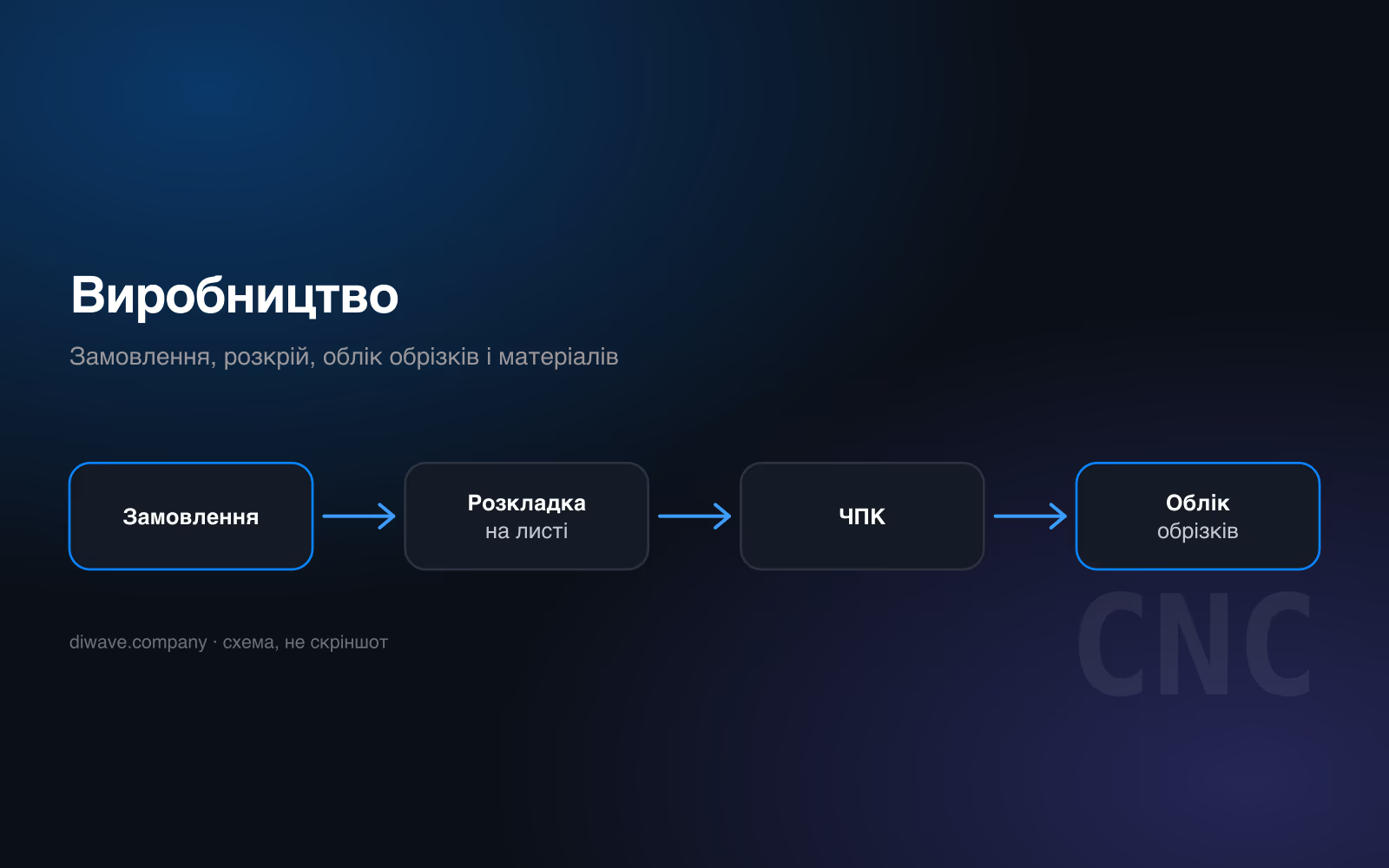
Rozkriy is a platform for CNC-cutting production: orders come in online, and parts are nested on the sheet accounting for rotation and kerf width.
Offcuts are recorded as an asset and offered to the next order. The nesting geometry was written for the job, so it can be tuned to the machine and the material.
The same engineer draws the part in CAD, generates the toolpath in CAM and writes the platform — nothing is lost in translation between disciplines.
How it works
1. The part in CAD
The geometry is modelled in SolidWorks or Fusion 360. Brackets and housings that cannot be bought are printed or milled on site.
2. The order arrives online
Orders are taken through the platform and reach production already nested, rather than as a list of parts somebody still has to work through.
3. Nesting on the sheet
Parts are nested accounting for rotation and kerf width. The nesting geometry was written for the job, so it can be tuned to the machine and the material.
4. The toolpath in CAM
Toolpaths are generated in Fusion CAM. The same engineer draws the part and writes the platform — nothing is lost in translation between the disciplines.
5. The offcut as an asset
What is left after the cut is recorded and offered to the next order. The offcut stops being invisible and no longer turns into scrap by default.
6. Telemetry from the line
Weight sensors turn material consumption into a number instead of a guess. A Raspberry Pi next to the equipment starts conveyors and pumps and reads the line.
Answers on this topic
Plain explanations without marketing — useful even if you never hire us.
An IoT/SCADA platform for a small plant: what you need
Seven layers of an IoT/SCADA platform: Modbus RTU/TCP over RS-485, gateway, telemetry, history, alarms, phone. Offline buffering, Raspberry Pi, security, cost.
SCADA on a budget: when a Raspberry Pi is enough
What monitoring a handful of sites really takes when industrial SCADA is oversized, and where a Raspberry Pi stops being the right answer.
RS-485 on site: what breaks and why
Why an RS-485 bus works on the bench and fails on site: termination, ground loops, cable length, star wiring, noise, Modbus RTU timing. How to diagnose it.
SCADA, CRM and ERP: how they differ and what you need
Plain explanations of the difference between SCADA, CRM, ERP and WMS. What each one is for and why replacing one with another usually ends badly.
SCADA dashboard: what the owner should see
A SCADA home screen for the owner, not the engineer: five questions it must answer in ten seconds, what to remove, and how to keep alarms worth trusting.