Lasso.ai — AI sales intelligence platform
Part of building an AI platform for B2B sales automation and lead generation
About the platform
Lasso.ai is an AI platform for sales teams, built to find new revenue. It indexes businesses with websites and LinkedIn pages and returns verified contacts from more than 500 million professional profiles.
Key capabilities
- ✓ AI-driven contact discovery and verification
- ✓ 100% net-new contacts, not CRM duplicates
- ✓ Bounce rate under 5%
- ✓ Real-time results instead of a static database
- ✓ Custom contact data on demand
- ✓ HubSpot and other CRMs integrated
Client results
Diwave expertise
- • High-load SaaS platforms
- • AI/ML integration for B2B sales
- • Data verification and validation systems
- • Real-time processing of large data volumes
- • CRM integration and automation
Technology
What we contributed
- ✓ Architecture for high-load data processing
- ✓ AI/ML for contact discovery and verification
- ✓ Real-time analytics
- ✓ Scalable SaaS infrastructure
- ✓ CRM integrations delivered
How it runs
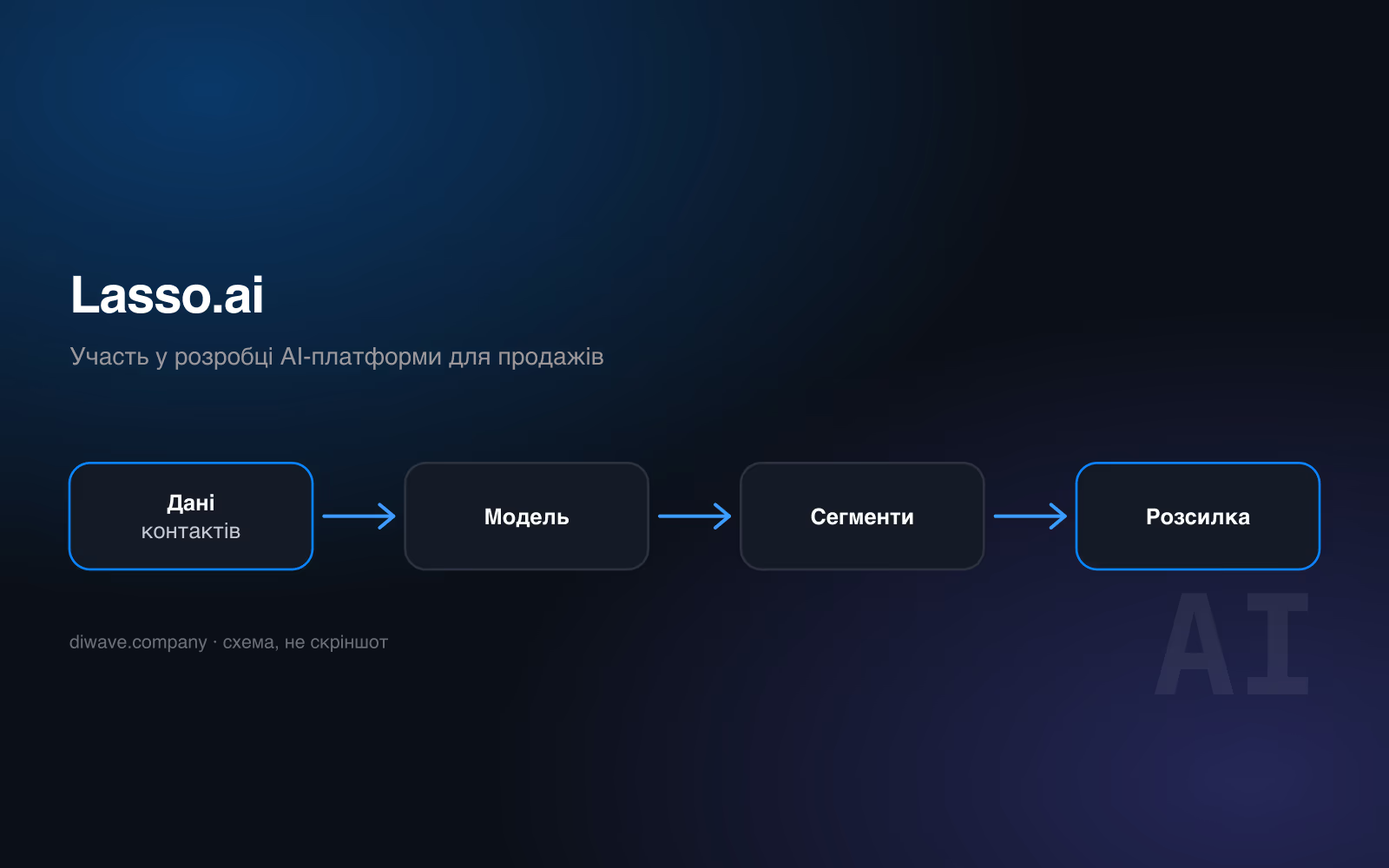
The platform starts from an index: businesses that have a website and a LinkedIn page become records rather than rows in a bought list. AI then finds contacts for them and verifies each one — and verification, not the presence of a row in a table, is what separates a usable contact from rubbish. The answer is assembled in real time, so a sales team works with what is true today rather than with an export that went stale on the way.
The next step is the check against the client's CRM. A contact the team already holds is worth nothing, so the platform returns only net-new records, and the HubSpot and CRM integrations make that comparison automatic. The list that comes back is shorter than it could be — and that is exactly why it is useful.
Underneath all of it sits high-load SaaS infrastructure: large data volumes, queues, real-time analytics. That is where the Diwave contribution sits — the processing architecture, the data verification and validation systems and the integrations, rather than the pages wrapped around them.
What to check before starting a similar project
- • Where a contact comes from and who is responsible for it being current. A static database ages between exports; a real-time answer costs more in infrastructure, but it is the only one that returns an address still alive.
- • How a duplicate is counted. Without a check against the client's CRM, part of the "new" contacts turn out to be records they already hold, and trust in the whole list drops at the first one.
- • What "verified" actually means. Checking the format, checking the domain and checking deliverability are three different things, and the bounce rate depends on the last of them.
- • Which CRMs are actually in use. A HubSpot integration does not cover a team living in a different system, and that list has to be known before the architecture, not after it.
- • Whether the processing survives peak load. An index of hundreds of millions of profiles is a pipeline, not a table query, and its bottleneck only shows itself under load.
FAQ
How is this different from a bought contact database?
A bought database is a snapshot taken at some point and identical for everyone who bought it. Here the answer is built at the moment of the request and checked against the client's CRM, so only contacts the team does not yet have remain in it.
What keeps the bounce rate low?
Verification before delivery rather than after a campaign. A contact is checked at the moment it is found and enters the result already verified — which is why few messages come back.
Which part of this did Diwave build?
The architecture for high-load data processing, the AI/ML integration for contact discovery and verification, real-time analytics, scalable SaaS infrastructure and the CRM integrations. This was participation in building the platform, not sole authorship of it.