Unattended payments
The car pulls up and the wash begins
A camera reads the plate. The system recognises the customer, opens their balance and starts the chosen programme.
No card, no phone, no wallet.
- 01Arrival
The car stops at the bay
- 02Plate
The camera reads it in a second
- 03Match
The system finds the customer and their balance
- 04Start
The programme starts by itself
Plenty of people can wire up a bill acceptor. Far fewer can make the vehicle identify itself on arrival and still get the receipt to the tax authority afterwards.
A test bench on the kitchen table
A bill acceptor on a stand, real banknotes, the interface in a browser, a wash programme being chosen. This is what it looks like while it is being built — before it becomes a cabinet on a concrete forecourt.
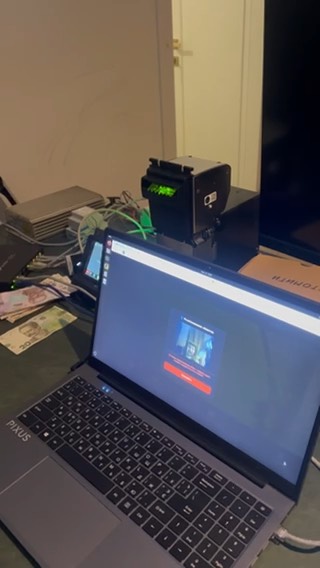
Filmed on a phone during debugging
Four ways to recognise the customer
The first works with no human involvement at all. The other three are there for when it does not.
Vehicle plate
The terminal connects to a plate database. Cameras read the plate on arrival, the system matches it to a customer and opens their balance. At an automatic wash the customer does nothing at all: they drive up and the wash starts.
Face
Facial verification — Face ID.
NFC card
A contactless customer card.
Phone number
The simplest route when nothing else is to hand.
What the system includes
- Taking payment
Cash, coins, tokens and contactless bank payment in one device. It talks to the hardware directly: MDB, ccTalk, bill and coin acceptors, card readers.
- Payment without the terminal
The customer scans a QR code and lands on a page with the bay and location already selected. They top up from the phone, or sign in and pay from an existing balance.
Open the live payment service- Cloud
Terminals synchronise upward. These are not isolated islands whose takings are collected by hand once a month.
- Owner dashboard
Every transaction: who washed, when, how much. Plus a load profile per location, so you can see when there is a queue and when the bays stand idle.
- Customer portal
Their own transactions and receipts.
Open the portal- Fiscal module
Receipts reach the tax authority. This is the part where solutions that demo well usually stop.
Where it works
The hardware and the protocols are the same everywhere a person pays a machine with no cashier. Only the on-screen scenario changes.
- Self-service car washes
- Vending machines
- Laundromats
- Top-up kiosks
- EV charging
- Parking and lockers
What it costs
Adapting the existing system to your equipment starts at from €6,800, typically four to six weeks. Support after handover is €320/mo.
Give me a budget range in your first message and I will tell you straight away what it buys and what it does not. It saves us both a week of email.
Tell me about your setupAnswers on this topic
Plain explanations without marketing — useful even if you never hire us.
Unattended payments: what actually breaks outdoors
What fails in an unattended terminal standing outside: note acceptors in frost, dropped links, receipts, reconciliation. From a network that runs today.
Wero and ENP: what changes for unattended terminals
Europe is building its own account-to-account payment network, ENP and Wero. What it means for car washes and vending, and how to prepare now.
Inside a self-service car wash terminal
What a car wash terminal is made of: plate recognition, payment acceptance, fiscal receipts, controller link, telemetry. What breaks first and why.
What payment terminal software costs
What goes into self-service terminal software: payments, offline operation, till reconciliation. What drives the price up, and why no calculator fits.
What it costs to add payments to equipment you already own
What decides the cost of adding card, QR and cash payments to equipment on site: interface, Modbus, MDB, ccTalk, payment routes, fiscal receipts, offline.