EV Charging & e‑Mobility
We take payment without a cashier, poll the station controller, account for sessions in kWh and show revenue per site. We do not make stations.
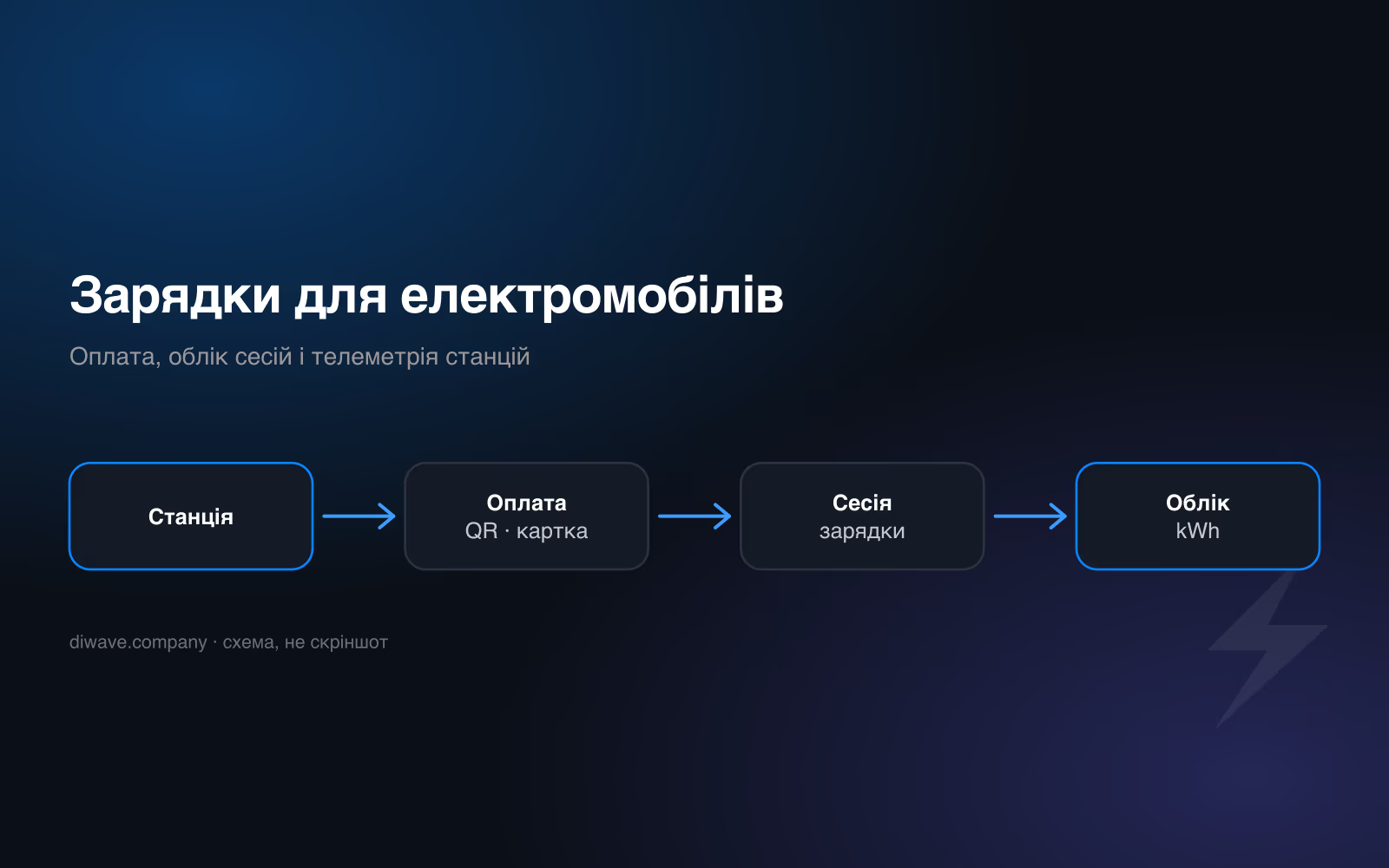
Why a charging station is the same problem as a car wash
The device stands unattended, takes money, delivers a service and must report honestly about it. Technically that is exactly an unattended car wash: controller, payment acceptance, accounting, reconciliation and telemetry.
The problems are the same too. The station stops — you hear it from a customer. How much a given site earned in a day is counted by hand. Payment went through but charging did not start — sorted out after the fact.
What we do
Payment without a cashier
Contactless card, QR from a phone, pre-authorisation with settlement on actual use.
Talking to the station
Polling the controller, starting and stopping sessions, reading consumed energy.
Session accounting
Who, when, how many kWh, for how much. Per-session data, not just a monthly total.
Downtime alerts
The station is down — the person who will drive out hears about it immediately.
Owner panel
Revenue per station, hourly utilisation, payback per site.
Incomplete sessions
Paid but not charged — a separate log and an alert, rather than a lost customer.
What it runs on
Modbus to talk to the station controller, acquiring integration, MQTT for events. Node.js and PostgreSQL on the server. We do not manufacture stations: our part is the software that drives them and counts the money.
Our evidence
The same stack has run a self-service car wash network for years: over 14 million payment transactions. An unattended point with cash, cards and daily reconciliation is a problem we have already solved under load.
Frequently asked
Do you make the stations?
Will it work with any manufacturer?
How many stations do we need?
Answers on this topic
Plain explanations without marketing — useful even if you never hire us.
Card payments for vending machines without a cashier
MDB reader, bank terminal or QR: three ways to take cashless payments on a machine, fiscal receipts without a cashier, per-machine reconciliation, offline mode.
Fiscal receipts from a terminal with no cashier
How a receipt reaches the tax authority from an unattended terminal: who issues it, when, what happens when the link drops, and where the gap usually appears.
Telemetry where the link drops for hours
Telemetry where the mobile link drops for hours: store-and-forward, clock drift, deduplication, staleness on the dashboard, alerts that do not cry.
Modbus: what it is and why your business should care
Plain explanation of Modbus RTU and TCP: how equipment exposes data, the difference between RTU and TCP, and what to do if your device does not support it.